Concrete gets all the credit, but steel does the heavy lifting. Every slab, footing, wall, and deck poured in Southern California depends on reinforcing steel placed exactly where the engineer intended, and that is precisely where projects succeed or quietly fail. Choosing the right rebar contractor Riverside CA builders trust is not a procurement detail. It is a structural decision. Once concrete is poured, the reinforcement inside is invisible and essentially permanent, which means there are no second chances to get it right. Here is why experience in this trade matters more than almost any other line item on your bid sheet.
What Reinforcing Steel Actually Does
Concrete is remarkably strong in compression but weak in tension. Load it the wrong way and it cracks. Reinforcing steel solves that problem by carrying the tensile forces concrete cannot handle on its own.
Properly engineered and installed reinforcement:
- Carries tension loads in slabs, beams, footings, and walls
- Controls cracking from shrinkage and temperature changes
- Ties structural elements together so they behave as one system
- Provides the ductility that lets structures flex instead of fail
That last point deserves emphasis in our region. The Inland Empire sits in earthquake country, and California’s seismic design requirements exist precisely because reinforcement detailing determines how a structure performs when the ground moves. The difference between code-compliant reinforcement and “close enough” can be the difference between repairable damage and catastrophic failure.
Why Placement Quality Decides Structural Integrity
Here is the truth most people outside the trade never hear: the engineer’s drawings are only half the equation. Structural integrity is built in the field, bar by bar, tie by tie.
Position Is Everything
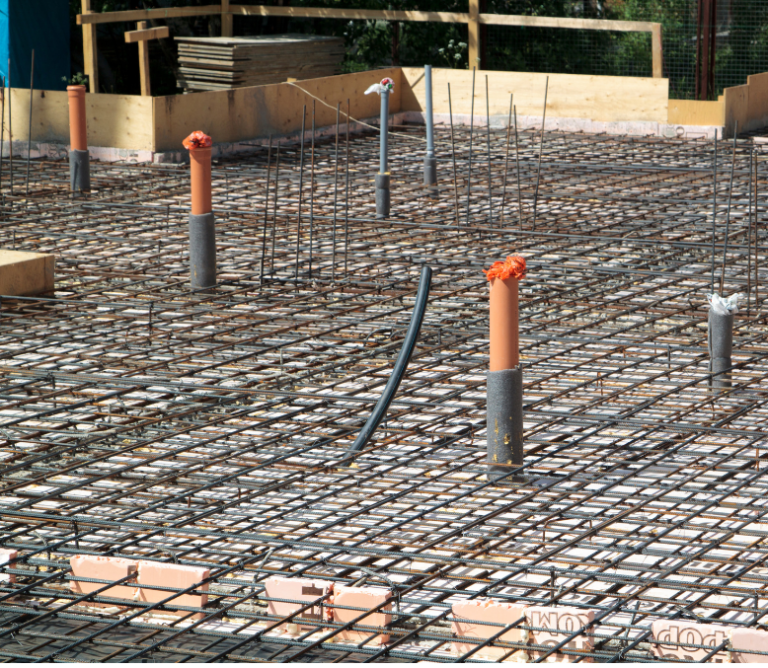
Rebar works only when it sits where the design puts it. A few critical examples:
- Concrete cover. Bars need a specified distance from the surface. Too little cover invites corrosion; too much reduces structural capacity.
- Bar spacing. Spacing affects how loads distribute and how concrete consolidates around the steel.
- Lap splices. Where bars overlap, the length of that lap determines whether forces transfer properly from one bar to the next.
- Chairs and supports. Steel that sags to the bottom of a slab during the pour contributes almost nothing. Proper supports keep it at design height.
An experienced reinforcing steel contractor reads structural drawings fluently, catches conflicts before the pour, and places steel that passes inspection the first time.
Post-Tension Systems Raise the Stakes
Post-tension cable installation adds another level of precision. PT systems use high-strength steel tendons stressed after the concrete cures, allowing thinner slabs, longer spans, and better crack control. They are common in commercial decks, residential foundations on expansive soils, and parking structures across Riverside County.
But post-tensioning is unforgiving. Tendon profiles must follow exact heights, anchorages must be set correctly, and stressing operations require trained crews and calibrated equipment. Mistakes are expensive at best and dangerous at worst. This is specialist work, not a task to hand to a general labor crew.
The Real Benefits of an Experienced Rebar Contractor
Inspections Pass the First Time
In California, reinforcement is subject to inspection before every pour, and deputy inspectors check placement against approved plans. Failed inspections mean rework, schedule slips, and idle concrete crews. Experienced contractors build to pass, with clean tying, correct laps, proper cover, and documentation ready. On fast-track commercial projects in Ontario, Fontana, or Corona, that reliability protects the entire schedule.
Schedule Certainty
Rebar sits on the critical path. Concrete cannot pour until steel is placed, inspected, and signed off. A seasoned crew sizes its manpower to the pour schedule, sequences work with other trades, and does not become the bottleneck. Ask any superintendent what a missed pour date costs, and you will understand why low-bid steel crews are often the most expensive choice on the project.
Fewer RFIs, Fewer Surprises
Experienced reinforcing crews catch drawing conflicts, congestion problems, and constructability issues early, when they cost nothing to fix. A foreman who has placed steel for two decades will flag a beam-column joint that will not fit before fabrication, not after the truck arrives.
Safety and Accountability
Reinforcing steel is physically demanding, high-risk work involving heavy material, impalement hazards, and coordination with cranes and other trades. Professional contractors bring trained crews, proper safety programs, and full insurance, protecting the GC and owner from liability that unqualified labor creates.
Common Mistakes That Compromise Structural Integrity
After years on Southern California job sites, these are the failures we see when reinforcement is treated as a commodity:
- Steel placed too low or too high because chairs and supports were skipped or crushed during the pour
- Short lap splices that cannot fully transfer load between bars
- Missing or misplaced dowels at construction joints, weakening the connection between pours
- Inadequate cover that leads to rust staining, spalling, and long-term corrosion damage
- Congested joints where bars physically cannot fit as drawn, resolved by field improvisation instead of engineering guidance
- Walking on unsupported mats, displacing carefully placed steel minutes before concrete arrives
- Untrained PT stressing, producing incorrect elongations and undocumented force records
Every one of these is invisible the day after the pour. Some stay invisible for years, until cracks, deflection, or corrosion reveal what happened inside the concrete. That is why structural reinforcement is a trade where experience is not a luxury. It is the product.
What to Look for When Hiring a Reinforcing Steel Contractor
Whether you are a general contractor, developer, or property owner in Riverside County, vet your steel sub like the structure depends on it, because it does:
- Relevant project history across residential, commercial, and industrial concrete construction
- Post-tension capability if your project uses PT, including trained stressing crews
- Plan literacy, with foremen who work from structural drawings, not habit
- Inspection track record, because first-time pass rates tell you everything
- Proper licensing and insurance for work in California
- Local presence in the Inland Empire, which means familiarity with area inspectors, suppliers, and soil conditions
A contractor who checks these boxes is not a cost. They are cheap insurance on everything you are about to pour.
Frequently Asked Questions
What does a rebar contractor do? A rebar contractor fabricates, places, and ties reinforcing steel inside concrete forms according to structural drawings. Their work includes footings, slabs, walls, columns, and decks, and often extends to post-tension cable installation. Proper placement directly determines the strength and lifespan of the finished structure.
Why is rebar placement so important for structural integrity? Concrete is weak in tension, so steel carries those forces. If bars are positioned incorrectly, spliced too short, or left without proper concrete cover, the structure cannot perform as engineered. Placement errors are sealed inside the concrete and are extremely costly to correct later.
What is the difference between rebar and post-tension reinforcement? Rebar is passive reinforcement that resists loads as they occur. Post-tension tendons are actively stressed after the concrete cures, compressing the slab to control cracking and allow thinner, longer spans. Many Southern California projects use both systems together.
Does reinforcing steel need to be inspected in California? Yes. Reinforcement is inspected against approved structural plans before concrete placement, and post-tension stressing requires documented force and elongation records. Experienced contractors build to pass inspection the first time, protecting the project schedule.
How do I choose a rebar contractor in Riverside CA? Look for proven local experience, post-tension capability if needed, proper licensing and insurance, crews who work directly from structural drawings, and a strong first-time inspection pass rate. References from general contractors in the Inland Empire are the best indicator of reliability.
Conclusion
Everything built in concrete lives or dies by what is inside it. The steel you cannot see after the pour determines how slabs carry loads, how foundations handle expansive soils, and how structures respond when Southern California shakes. That is why selecting an experienced rebar contractor Riverside CA projects can depend on is one of the highest-leverage decisions on any concrete job. Get the reinforcement right, and everything built on top of it stands on solid ground.